
If you’ve got a Toyota/Lexus running the 1UZ-FE V8 (often found in models like the LS400, Soarer, Crown, etc.), you’ve probably heard the stories: random running issues, weird intermittent faults, or an ECU that just seems “possessed.”
We’ve now seen multiple Denso 1UZ-FE ECUs come through with the same root cause: leaking electrolytic capacitors that damage the PCB tracks (see the photos attached).
This post explains what’s happening, what symptoms it causes, how we repair it properly, and why preventative capacitor replacement can be a smart move.
The problem: electrolytic capacitors leak with age
Inside these Denso ECUs are several electrolytic capacitors used for filtering and stabilising the ECU’s internal power rails. After decades of heat cycles and age, the seals break down and the capacitor electrolyte can leak out.
That electrolyte is corrosive and conductive. Once it leaks, it:
-
eats copper tracks and vias
-
contaminates nearby components
-
creates leakage paths that cause unstable signals
-
continues corroding even after the car is parked
In the photos you can see classic signs:
-
residue around capacitor bases
-
dark/dirty areas on the PCB
-
track damage near capacitor locations (burnt/green corrosion, missing mask, thinned copper)
Even if the ECU still “works,” the damage can be progressing silently.
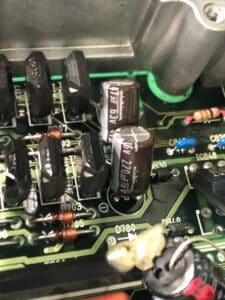
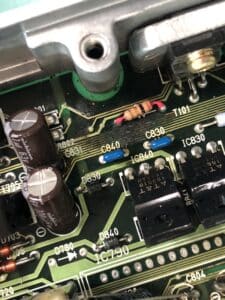
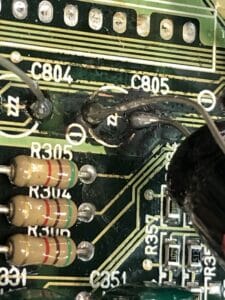
Above images show track damage. In some places, track is damaged but still connected, in other places, the track is completely cut.
Common symptoms of a failing 1UZ-FE ECU (cap leakage)
Cap leakage can show up in a bunch of ways depending on which circuit area is affected. We commonly hear:
-
Intermittent misfires or rough idle
-
Random stalling (sometimes hot or after a drive)
-
Hard starting, especially when warm
-
Unstable or incorrect sensor readings
-
Injector drive issues (running rich/lean inconsistently)
-
Check Engine Light with inconsistent or “impossible” codes
-
“Works one day, not the next” behaviour
Because leakage can affect multiple circuits, the symptoms often don’t point clearly to one sensor or one subsystem.
Why this repair needs more than “just swapping caps”
Some ECUs can be “saved” with a simple recap if caught early. But once electrolyte has leaked, a proper repair usually requires:
1) Removing the old capacitors safely
Old caps can be fragile and the pads underneath may already be weakened. Removing them the wrong way can lift pads or tear tracks.
2) Neutralising and cleaning the electrolyte
This is critical. If you only replace capacitors but don’t fully clean/neutralise the affected area, the corrosion can continue and the ECU can fail again later.
3) Track and via repair
In the attached photos, we can see track damage where electrolyte has attacked the copper. That may require:
-
rebuilding damaged traces
-
repairing vias / through-holes
-
restoring solder mask protection where needed
4) Replacing capacitors with quality equivalents
We replace with correct capacitance/voltage ratings and use quality, high-temperature parts suited for automotive environments. We are currently re-caping one ECU that had capacitors replaced in 2023. The repair was not done with correctly rated components so they failed again very prematurely.
5) Testing and validation
A repaired ECU should be checked for:
-
stable power rails
-
proper signal integrity in affected areas
-
no leakage paths remaining
Preventative maintenance: recapping before damage occurs
If you’ve got a classic 1UZ-FE vehicle that you plan to keep, preventative capacitor replacement can be a very good idea.
Why?
-
It can stop leakage before it eats tracks
-
It reduces the chance of an unexpected roadside failure
-
It’s often cheaper than a full track repair after corrosion has spread
Think of it like replacing timing belt components before they fail—except this time it’s inside the ECU.
Important: preventative recapping is most effective when done before leakage has started. If you’re already seeing residue, smell, or visible corrosion, it’s better to treat it as a full leak repair (clean + repair + recap), not a simple “cap swap.”
What to do if you suspect your ECU is affected
If you’re experiencing the symptoms above, or your ECU is original and decades old, the safest approach is:
-
Stop driving it hard until it’s checked (leakage can worsen with heat)
-
Consider getting it inspected before chasing sensors and replacing parts blindly
If you’ve already opened it up and seen any oily residue, dark staining, or corrosion—don’t clean it aggressively with random solvents. The wrong approach can spread contamination or damage the board further.
Need a Toyota Denso 1UZ-FE ECU repaired in NZ?
We repair ECU boards at component level, including:
-
capacitor replacement (recap)
-
electrolyte cleanup/neutralisation
-
track and via repair
-
board inspection for hidden corrosion
- controller chip replacement
You can bring/send the ECU to:
Device Repair Guy
148 Lambton Quay, Wellington
Phone: 027 531 0155