
We recently repaired an engine ECU (ECM) from a 2013 Volvo XC90 3.2 (P3 platform) with a charging system fault affecting the smart alternator LIN communication line.
This post explains the symptoms, diagnostics, bench testing results, and the ECU repair carried out — helpful if you’re seeing “generator communication” faults, charging warnings after start-up, or a Volvo alternator that appears to run in fallback mode.
Vehicle & Charging System Details
-
Vehicle: 2013 Volvo XC90 3.2 (P3 Platform)
-
Charging system: Bosch smart alternator with single-wire LIN control
-
Diagnostics used: Volvo VIDA OEM diagnostic software (DiCE-style interface)
Customer Symptoms
Primary issue: The ECM/ECU reported loss of communication with the generator/alternator (LIN-controlled).
When it happened: The warning appeared roughly 30 seconds after engine start.
Background: What Caused the Problem?
The root event was an overcharge condition caused by a failed alternator voltage regulator. System voltage went beyond normal regulation limits — a scenario that can damage sensitive ECU circuitry.
The customer had already attempted multiple repairs before sending the ECU in:
Repair Attempt 1 – Alternator Replacement (Incorrect Output Rating)
A replacement alternator was installed, but it was the wrong rating (150A).
This vehicle requires an 180A alternator, so the incorrect unit caused an undercharge condition. The alternator was removed.
Repair Attempt 2 – New Genuine Bosch LIN Regulator
The original alternator was kept and a genuine Bosch LIN-compatible regulator was fitted.
Charging became stable, but it sat around ~13.5V, consistent with fallback mode, and the LIN communication fault returned after ~30 seconds.
At that point, alternator and regulator were strongly suspected not to be the root cause.
In-Vehicle LIN Electrical Testing
Testing confirmed the alternator uses a single-wire LIN connector only.
Checks performed:
-
LIN wire tested for short to ground → passed
-
LIN voltage measured at alternator harness side (connected/disconnected):
-
Initially ~0.53V, later degraded to ~0.16V
-
-
Measurement repeated at the ECM connector (back-probed):
-
Same ~0.16V
-
What should have happened
Normally, when the alternator is disconnected, the LIN line should be pulled high (toward battery voltage) by the ECU/network pull-up circuitry.
What actually happened
The LIN line was held hard low, even with the alternator disconnected and external load removed.
Conclusion from vehicle testing:
The remaining realistic causes were:
-
a harness short-to-ground between ECM and alternator, or
-
an internal ECU fault (LIN driver/transceiver or protection circuit)
Given the earlier overcharge event, internal ECU damage was considered likely.
Why the ECU Was Sent In
The key finding was:
– LIN line low at the ECM pin with alternator disconnected
– Alternator + LIN regulator eliminated as the cause
So the ECU required bench testing of the LIN driver/pull-up circuitry.
Bench Testing Results (ECU Off-Vehicle)
We confirmed the LIN pin location and tested the ECU unpowered.
Diode-mode comparison test
-
Nearby pins (73–91): normal diode-mode reading around ~0.5V to ground
-
LIN pin (Pin 92): ~0.030V and effectively the same in both probe directions
Resistance to ground
-
Pin 92: low resistance to ground at approximately 15.5Ω

What this indicates
This pattern is consistent with the ECU’s LIN circuit being internally clamped/shorted to ground, typically caused by:
-
a failed surge protection component, and/or
-
a failed LIN transceiver/driver stage
This exactly matches the on-vehicle behaviour — a LIN line held low will prevent alternator communication and trigger the generator communication fault shortly after start.
ECU Repair Performed
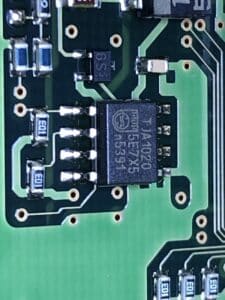
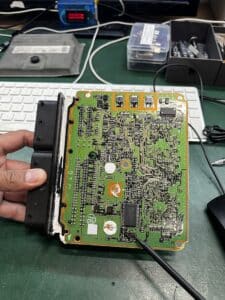
After approval, we opened the ECU and traced the LIN circuit from Pin 92 on the PCB.
Repair outcome
-
Found the ECU was internally pulling the LIN signal to ground
-
Replaced the LIN transceiver component
-
Confirmed the short was cleared and the LIN signal now tests normally on the bench
-
ECU was resealed and prepared for refit
Result & Next Step
The ECU is now ready to reinstall.
Recommended final check: Fit the ECU back to the vehicle and confirm:
-
the charging warning is gone
-
alternator communication is restored
-
charging voltage returns to normal smart charging behaviour
Why does the Volvo XC90 alternator fault appear after ~30 seconds?
Many Volvo smart charging systems perform a communication check shortly after start. If the alternator doesn’t respond on LIN, the ECU logs a generator communication fault and the warning appears.
Can an overcharging alternator damage the ECU?
Yes. Overvoltage events can damage ECU protection circuits and communication transceivers — including LIN drivers.
What does ~13.5V charging mean after replacing the regulator?
That often indicates fallback mode, where the alternator operates without proper LIN control and defaults to a safe output.
How do you tell if the LIN problem is wiring vs ECU damage?
If the LIN line is still held low at the ECU pin with the alternator disconnected, and wiring checks pass, that points strongly to an ECU-side fault.