
Shorted S560 Diode and Power Supply Capacitor Failure
We recently repaired another Apple HomePod with no power, and this is now the second unit we have seen with the same underlying fault.
The HomePod looked completely dead when it arrived. Because this fault sits deep inside the unit, diagnosis starts with a full disassembly. Anyone who has opened one of these before will know that getting to the power electronics takes time — Apple did not design the HomePod with easy board-level servicing in mind.
Once we had the unit apart, we traced the fault to a shorted S560 diode on the power supply board.

Finding the failed diode
After testing the power board, we confirmed that the S560 diode had failed short circuit.
This component is a known failure point on some HomePods. Replacing the diode can bring the power supply back to life, but we don’t treat the diode as the only possible problem.
We also inspect and replace the associated electrolytic capacitors, because ageing or failing capacitors can place additional stress on the circuit and contribute to diode failure.
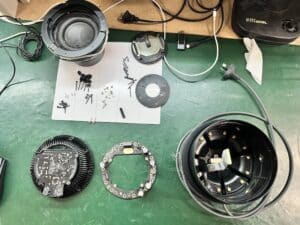
The photo below shows the HomePod fully disassembled while we worked through the power supply and amplifier sections.
Don’t replace only the diode
When repairing this fault, we recommend dealing with the surrounding power supply components at the same time.
On this HomePod we replaced the failed S560 diode and the relevant electrolytic capacitors. Replacing only the diode risks leaving the original cause of the failure in place.
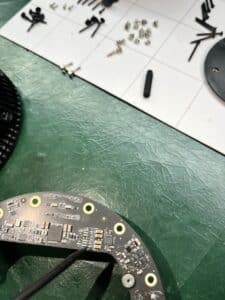
The photos show the capacitors we inspect and replace as part of this repair.
A useful source for the S560 diode
One of the biggest delays with this repair can simply be finding the replacement diode.
Many repair guides identify the failed S560 component, but they often leave you waiting for a replacement part to arrive from an overseas supplier.
We found a much faster option.
Check an old iMac logic board
We found the same type of diode on a 27-inch iMac logic board from around 2014 and used the donor component to complete the HomePod repair.
This has now helped us twice.
The donor iMac board in the photo actually has two empty diode locations, because we have now removed components from the same board for two separate HomePod repairs.
For a repair shop with older Apple logic boards available for parts, this can save a significant amount of time compared with ordering the diode internationally and waiting for delivery.
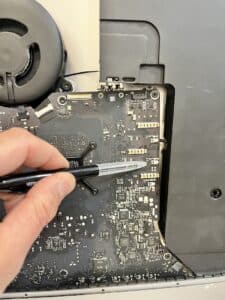
Naturally, we still test the donor component before fitting it and confirm that its electrical characteristics suit the circuit rather than relying only on the package marking.
Why does the HomePod fail this way?
The HomePod power supply has to generate several stable voltage rails for the amplifier, logic board and other internal electronics.
As electrolytic capacitors age, their electrical characteristics can deteriorate. A failing capacitor can increase ripple or place abnormal stress on other parts of the power circuit.
Eventually, components such as the S560 diode can fail short, leaving the HomePod completely unable to power up.
That is why we approach this as a power supply repair, rather than simply swapping one visibly failed component.
Component-level HomePod repair
After replacing the diode and capacitors, we reassemble the HomePod and test the power supply and full unit operation.
This particular repair required:
- full HomePod disassembly
- power supply diagnosis
- identifying the shorted S560 diode
- sourcing and testing a donor diode
- replacing the failed diode
- replacing the associated electrolytic capacitors
- reassembling the HomePod
- testing the unit after repair
This is now the second HomePod we have successfully repaired with this fault, which gives us a much better understanding of both the failure and the most efficient way to approach it.
At Device Repair Guy, we carry out logic board component-level electronics repairs rather than limiting repairs to complete board replacement. That includes Apple devices, laptops, game consoles, automotive modules and other electronics where board-level diagnosis makes repair practical.
If your Apple HomePod has suddenly stopped powering on, there may still be a repair option before replacing the entire speaker.