DRG Auto · Automotive Electronics Repair Wellington

ECU, TCU, ABS & Automotive Computer Repair

DRG Auto repairs vehicle electronic modules at component level where practical, helping workshops, auto electricians and vehicle owners avoid unnecessary module replacement.

We work on automotive control units such as ECU/ECM, TCU/TCM, ABS/ESP, EPCU, BCM, EPS, instrument clusters and other electronic modules. Our work focuses on board-level inspection, electronic fault finding, component replacement and practical repair assessment.

Automotive Electronic Modules We Repair

Modern vehicles rely on multiple electronic control modules. When one fails, replacement can be expensive, unavailable, or require coding. DRG Auto assesses the original module and repairs it where practical.

ECU / ECM Repair

Engine control units can fail due to power supply faults, failed drivers, corrosion, heat damage, cracked solder joints or internal communication faults.

  • No communication with ECU
  • No start or intermittent start faults
  • Injector or ignition driver faults
  • Power supply and ground circuit faults
  • Water damage and corrosion
  • Capacitor leakage and board contamination
TCU / TCM Repair

Transmission control modules can cause shifting faults, limp mode, solenoid control issues or no communication when the internal electronics fail.

  • No communication with TCU / TCM
  • Transmission limp mode electronics faults
  • Solenoid control circuit faults
  • Connector and internal board issues
  • Power and ground circuit assessment
  • Corrosion or liquid damage checks

ABS / ESP Module Repair

ABS and stability control modules often fail internally, causing warning lights, communication faults or intermittent braking system errors.

  • ABS warning light faults
  • ESP / traction control module faults
  • Communication faults
  • Internal circuit faults
  • Connector and bond wire issues
  • Board-level inspection under magnification

EPCU & Other Vehicle Modules

We also assess other automotive electronic modules where component-level repair is practical and the fault can be investigated on the bench.

  • EPCU power control modules
  • BCM body control modules
  • EPS electric power steering modules
  • Instrument clusters and display faults
  • Infotainment and head unit faults
  • Diagnostic scanner tablet repairs

What Component-Level Automotive Electronics Repair Looks Like

Automotive computer repair is different from ordinary scan-tool diagnosis. Once the module is on the bench, we inspect the circuit board, test electronic sections and repair failed components where possible.

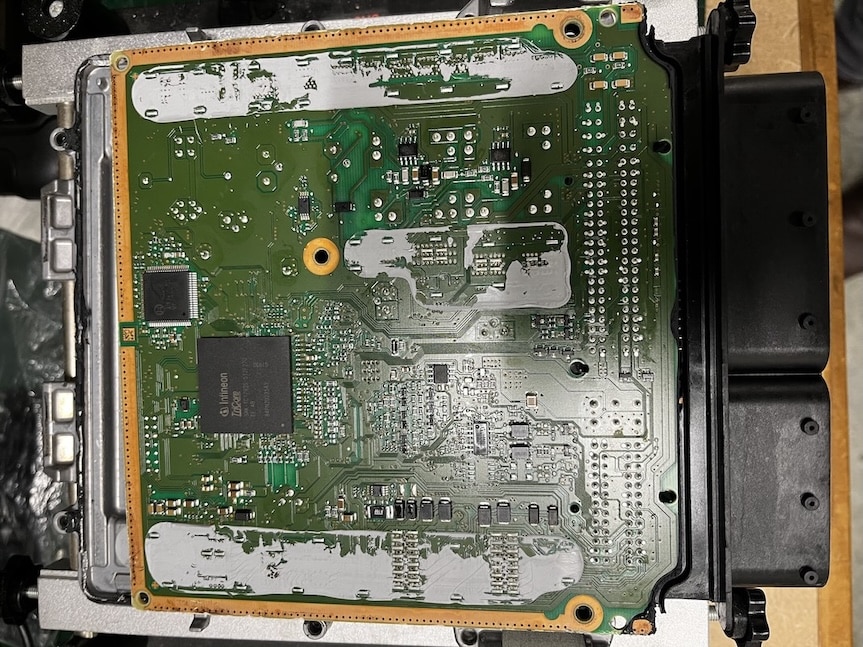
Internal circuit board view of an automotive ECU

Internal Board Inspection

We open the module and inspect the board for visible damage such as corrosion, burnt components, cracked solder joints, contaminated areas, damaged tracks and signs of previous repair attempts.

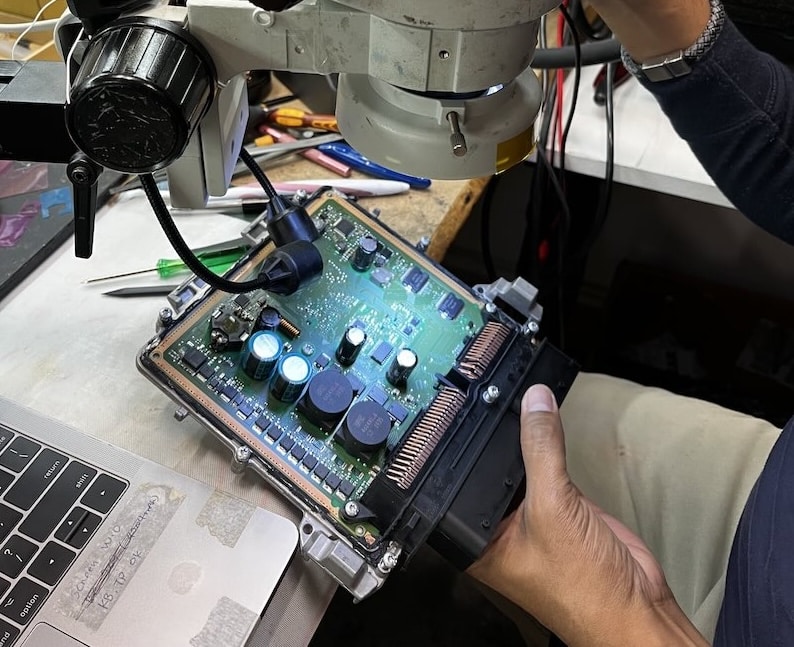
Automotive ECU circuit board being inspected under a microscope

Microscope Inspection

Many module faults are too small to see clearly by eye. Magnification helps us inspect fine-pitch components, solder joints, corrosion around ICs and damage near connectors or driver circuits.

ECU module connected to diagnostic equipment for bench testing

Bench Testing

Bench testing helps us check power, ground, communication and obvious electronic behaviour before deeper repair work. It is useful for confirming whether the fault is likely inside the module.

Common Faults We Look For

Vehicle symptoms can come from the module, wiring, sensors, power supply, software or other vehicle-side faults. Our work focuses on the physical electronic module once it has been removed for assessment.

No Communication

A diagnostic scanner may fail to communicate with an ECU, TCU, ABS module or BCM due to internal power supply faults, damaged communication transceivers, corrosion or board-level damage.

No Start or Intermittent Start

Engine computer faults can affect relays, injectors, ignition control, immobiliser communication or sensor circuits, causing no-start or intermittent-start symptoms.

Warning Lights and Limp Mode

ABS, ESP, transmission and engine warning lights may be caused by internal module faults, but wiring, sensors and vehicle-side issues should also be ruled out by the workshop.

Water Damage and Corrosion

Moisture ingress, capacitor leakage, poor sealing, battery faults and previous repair attempts can cause corrosion, damaged tracks and intermittent electronic faults.

Support for Auto Electricians and Workshops

DRG Auto is designed to support workshops when the vehicle-side diagnosis points toward a faulty module and the unit needs electronic assessment.

When We Are Useful

  • The replacement module is expensive or hard to source
  • The original module has coding, immobiliser or compatibility issues
  • The fault appears to be internal to the ECU, TCU, ABS or EPCU
  • The workshop has diagnostic codes or symptoms pointing to module failure
  • A component-level repair may avoid unnecessary module replacement

Where Workshop Notes Help

Diagnostic notes, fault codes, vehicle symptoms and testing already performed by the workshop help us focus the bench assessment. The clearer the fault history, the easier it is to avoid guesswork.

We are not replacing the role of the mechanic or auto electrician. We focus on the electronic module itself.

```

Why Repair the Original Module?

```

Replacement is not always the best first option. If the original unit is repairable, it may reduce delays, avoid coding problems and preserve the vehicle’s existing configuration.

01

Preserve Original Coding

Repairing the original ECU, ABS or TCU can avoid compatibility, immobiliser and programming issues that may occur with used replacement modules.

02

Reduce Replacement Cost

Component-level repair can be more economical than sourcing a new module, especially for rare, discontinued or back-ordered vehicle computers.

03

Recover Hard-to-Find Units

Some modules are difficult to replace quickly. Repairing the original unit can be useful when replacement stock is limited or vehicle downtime matters.

04

Board-Level Experience

Our background in logic board repair, microsoldering and electronics troubleshooting carries across to many vehicle modules and diagnostic tools.

```

Repair Limits and Practical Expectations

```

Not every automotive module can be repaired. Some faults are caused by the vehicle, some are intermittent, and some modules are too damaged or too restricted to repair economically.

Often Good Candidates

  • Visible corrosion or board contamination
  • Failed capacitors, relays, drivers or transceivers
  • Cracked solder joints or damaged tracks
  • Power supply faults inside the module
  • Known module faults with repairable failure points

Sometimes Not Repairable

  • Severe water, fire or physical damage
  • Intermittent faults that cannot be reproduced
  • Unavailable programmed ICs or locked data
  • Vehicle-side wiring, sensor or power faults
  • Modules that require vehicle-side programming after replacement
```

Workshop Posts and Repair Examples

```

These examples show the types of automotive electronic modules and related diagnostic equipment we inspect or repair.

Auto Diagnostic Scanner Repair

Repair support for diagnostic scanner tablets used by mechanics and workshops, including Autel, Launch and similar tools.

Engine Control Unit Repair

ECU repair workshop example showing internal board inspection, connector layout and typical failure modes.

```

DRG Auto Repair Centre

```

DRG Auto operates from Device Repair Guy in Wellington CBD. Modules can be brought in or couriered to us after the correct intake form has been completed.

Before Sending a Module

Please use the repair process page to choose the correct intake form before sending a module. This helps us capture the vehicle details, fault symptoms, diagnostic codes and module information needed for assessment.

For this service, we usually need the module itself rather than the whole vehicle.

```

Related DRG Electronics Services

```

DRG Auto is part of Device Repair Guy’s wider board-level electronics repair service in Wellington.

```

Auto Electronics Repair FAQs

```
Do you repair ECU and ECM modules?

Yes. DRG Auto inspects and repairs many engine control units at component level, including power faults, communication faults, corrosion, capacitor leakage and board damage.

Do you repair ABS and ESP modules?

Yes. We inspect ABS and ESP control modules for communication issues, internal circuit faults, connector faults, bond wire issues and board-level damage.

Can you repair TCU or TCM transmission modules?

We can inspect TCU and TCM modules for no communication, power faults, corrosion and internal board issues. Repairability depends on the module construction and fault type.

Do you repair EPCU modules?

We can assess EPCU modules and other power control modules case by case. Repairability depends on the construction of the module, the fault type and the availability of replacement components.

Can every automotive computer be repaired?

No. Some modules are sealed, severely damaged, affected by vehicle-side faults, or require programmed ICs that are not available. We assess whether component-level repair is practical.

```
Scroll to Top