
Ford EcoSport TCM/TCU Repair – Finally Getting CAN Traffic on the Bench
Ford EcoSport transmission control module faults can be frustrating, especially when the vehicle has already had mechanical transmission work completed and the usual relearn/adaptive procedures still do not resolve the issue.
We recently worked on a Ford EcoSport TCM / TCU, part number AE8P-14F085-AE, also related to the Ford Powershift-style TCM units used across some EcoSport, Fiesta, and Focus models. This one came in with no drive in any gear and fault codes including:
- P287B-00-2
- P2827-00-2
The vehicle had already had gearbox and internal clutch mechanical work carried out, the software was reported as updated, and relearn procedures had been attempted without success. Power, ground, harness, and connector checks had also passed.


Initial Findings
This was not a simple “plug in and clear the code” type of repair. The module had been worked on more than once, and earlier testing pointed toward abnormal readings around the power driver section.
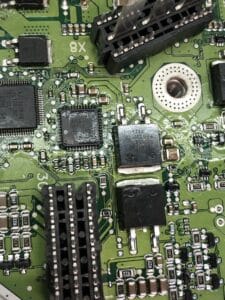
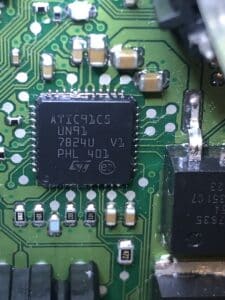
During board-level diagnosis, we identified a degraded BUK7635 MOSFET. We replaced the failed MOSFET, the companion MOSFET, and a nearby ST driver/controller IC. After the component replacement, readings around the power stage returned to normal.
Board-Level Testing
Once the repair work was completed, we bench-powered the module and checked the important power and logic rails.
We confirmed:
- MCU VDD present at approximately 1.5V
- MCU VDDP present at approximately 3.3V
- Reset and test lines active
- Crystal oscillator activity on XTAL1 and XTAL2
- CAN transceiver supply present
- CAN TxD and RxD activity
- CANH and CANL activity on the oscilloscope
The key breakthrough was that this time we were finally able to detect CAN traffic from the TCM on the oscilloscope. That confirmed the module was not completely dead on the bench and that the processor and communication side were showing activity.
Scan Tool Communication
Our Autel diagnostic tool was still unable to communicate with the module on the bench. However, based on the oscilloscope results, that may be due to tool support or protocol limitations rather than the TCM being completely non-functional.
This is why oscilloscope testing is so important for ECU and TCM repairs. A scan tool may say “no communication”, but direct electrical testing can show whether the module is actually powered, clocking, and attempting to communicate.
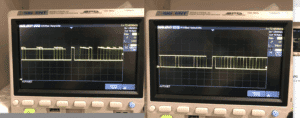
CAN Traffic
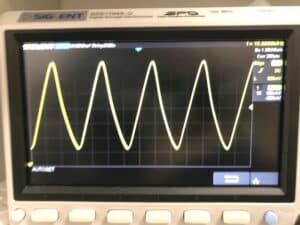
After replacement, chip clock can be detected on oscilloscope.
What We Repaired
On this Ford EcoSport TCM, the board-level work included:
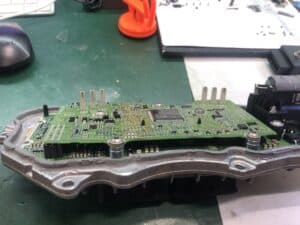
- Inspection of the Continental / Siemens VDO style TCM board
- Bench power-up testing
- Power rail verification
- MOSFET testing and replacement
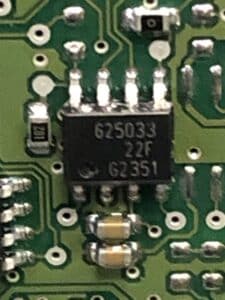
- ST driver/controller IC replacement
- Oscillator testing
- CAN transceiver testing
- CANH / CANL oscilloscope verification
After repair, the module showed good signs of life on the bench. The power rails were present, the oscillator was running, and CAN activity was visible.
Replaced components:
Final Notes
This repair is a good example of why automotive module repair often takes more than one attempt. These units can have multiple related failures, and it is not always possible to confirm the full result until the module is reinstalled in the vehicle.
Based on our bench testing, there was no evidence of a dead MCU, failed CAN transceiver, or failed lower-board power/driver stage after the repair. The next step is in-vehicle testing to confirm scan tool communication, clear fault codes, run adaptive/relearn procedures if needed, and check whether the original transmission faults return.
If the module communicates in the vehicle but the same codes remain, the remaining issue may be outside the repaired TCM power-driver section, such as the actuator, clutch, internal transmission control, or mechanical side.
At Device Repair Guy, we carry out board-level diagnosis and repair on selected automotive modules, including transmission control modules, ECUs, and other electronic control units.
If you have a Ford EcoSport, Fiesta, or Focus TCM fault, contact us to discuss inspection and repair options.