
We recently received an unusual automotive electronics module for repair: an N2MB Racing WOT Box.
Unlike a typical phone, tablet, or laptop repair, this device is used in performance vehicles. A WOT Box is an aftermarket control module designed for features such as no-lift shifting and launch control, helping drivers manage ignition cut and throttle-related functions during high-performance driving.
The customer advised that the unit had stopped working and that a small diode on the circuit board appeared to have failed. On inspection, he has found visible damage around one of the diode positions on the board. The component was marked on the PCB as Z4, which gave us an important clue straight away.
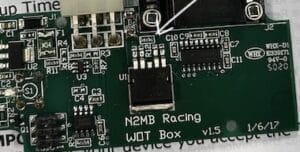
On circuit boards, a component marked with D is usually a standard diode, while a component marked with Z often indicates a Zener diode or voltage-clamping protection diode. These are commonly used to protect sensitive electronics from over-voltage, reverse polarity, or voltage spikes. In an automotive environment, this type of protection is especially important because modules can be exposed to ignition noise, alternator spikes, incorrect wiring, and other harsh electrical conditions.
The challenge was that the diode itself was damaged, so simply replacing it with a random diode would not be a safe or reliable repair. Before choosing a replacement, we needed to work out both the type and likely value of the original component.
The first step was to inspect the damaged diode under magnification and look for any remaining markings. Small glass diodes can sometimes have very faint markings printed on the body, such as a voltage code or part number. For example, a Zener diode may be marked with values such as 5V1, 12V, or another abbreviated code that indicates the clamping voltage. In some cases, heat damage can make these markings difficult or impossible to read.
Next, we checked the diode electrically with a multimeter. A standard diode test can confirm whether the component behaves like a normal silicon diode in one direction, but it does not always reveal the Zener voltage. If the diode has failed short-circuit, which is common for protection components, it may read as shorted in both directions. That result helps confirm the failure, but not necessarily the correct replacement value.
To narrow it down further, we traced the circuit around the failed diode. This is often the most important part of the process. By checking continuity from each side of the diode to nearby components, ground, power, and connector pins, we can understand what job the diode was doing. If one side of the diode connects to ground and the other side connects to an external input or signal line, it is very likely acting as a voltage clamp. If it is connected across a 12 V supply rail, then it may be protecting the board from power spikes. If it is connected to a logic input, it may be a lower-voltage clamp, such as around 5 V.
Because the board is used in a vehicle, we also considered the environment the diode was designed for. Automotive electronics often need protection from brief but high-energy voltage spikes. A failed diode in this position may not be the original cause of the fault — it may have sacrificed itself to protect the rest of the circuit from an external wiring issue or voltage surge.
Once we had a better understanding of the circuit, the damaged diode was removed and the surrounding area was cleaned. We then fitted a suitable replacement component based on the diode’s role in the circuit, its board marking, any readable markings from the original part, and the voltage level of the line it was protecting. The solder joints were inspected under magnification to ensure a clean and reliable connection.
This repair is a good example of why board-level diagnostics are more than just replacing a visibly damaged part. When a small protection diode fails, it is important to understand why it failed, what part of the circuit it protects, and what value the replacement needs to be. Installing the wrong diode could either leave the circuit unprotected or cause the new component to fail again.
Specialist electronics like automotive control modules are often difficult or expensive to replace, so careful component-level repair can be a practical option. At Device Repair Guy, we inspect, diagnose, and repair a wide range of circuit boards — from phones and laptops through to unusual modules like this N2MB Racing WOT Box.
Find out more about automotive electronic repair.
If you have a damaged control module, performance electronics unit, or another circuit board that needs inspection, our team can assess it and advise whether a repair is possible.
Contact us today